




At a busy table, the sound you want is not necessarily the loudest sound. Target-speech research asks whether a listening device can learn one person’s voice quickly enough to help a wearer follow it through competing conversation.
A noisy example becomes a voice target
The University of Washington’s Target Speech Hearing project, presented at CHI 2024, uses a brief period of looking towards a speaker to capture a noisy voice example. A model then tries to extract that speaker from other sounds. The research team describes operation on an embedded processor and tests in different acoustic environments. This is a research system, not evidence of an approved treatment for hearing loss. University of Washington
Choosing what matters
The design is interesting because it gives the wearer a clear way to express a preference. Rather than asking a model to decide what matters, a person selects a voice. But a dinner conversation can move rapidly between people, and selecting one voice may become a burden if the interface is awkward.
For women over 50, a relevant evaluation would include different listening abilities, accents and comfort with the controls. A cleaner audio signal does not itself prove that listening becomes less tiring or that words are understood more accurately. Those are different outcomes worth measuring.
The wearer supplies the first clue
The interface asks the wearer to look towards a chosen speaker for a few seconds. That short, noisy example becomes the starting point for identifying the voice later in the mixture. The important feature is that the system does not require a studio-quality recording of the person before the conversation begins. It tries to learn from the very environment in which assistance is needed.
The project reports a 7.01 dB signal-quality improvement with less than five seconds of enrolment audio. Decibels here describe an audio-processing result. They do not mean a listener understood 7% more words, nor establish how much less tiring a meal became. The technical achievement and the listening outcome belong on different lines of the evidence ledger. Project and paper
A dinner table is not a single-speaker task
Imagine a conversation in which a friend across the table is answering a question, then someone beside you adds a detail. Keeping the first voice prominent may help for one moment and become inconvenient in the next. A good listening interface therefore needs a practical way to change the target, hear the wider scene and recover from a mistaken choice.
This is a question about agency as well as accuracy. When the user chooses the speaker, the selection is understandable. The trade-off is the work required to keep that choice current. An automatic conversation-following system makes a different bargain: less explicit selection, but more inference by the software. Neither approach wins in every social situation.
A useful comparison for readers
The companion conversation-aware audio article explores that automatic approach. Read the two together as competing interface ideas, not as products in a shopping contest. One begins with a chosen voice; the other tries to infer who belongs to an ongoing exchange. The distinction is more informative than the shared description of both as AI headphones.
For women who enjoy busy restaurants, clubs or family gatherings, the potential benefit is participation. A future study that measures speech understanding and listening effort in those settings would move the story closer to that goal. It should also explain the cost of mistakes, the effort of using the controls and what happens to sounds outside the selected conversation.
The present result makes a difficult technical task more plausible. The unresolved question is whether selecting a voice can become an easy, repeatable action within a real social exchange, without asking the wearer to become the conversation’s sound engineer.
The next test is conversational
Selection needs testing when the speaker turns away, another person joins or a warning sound occurs nearby. The frontier is not simply removing noise; it is helping the wearer remain in control of what they hear.
The idea in view
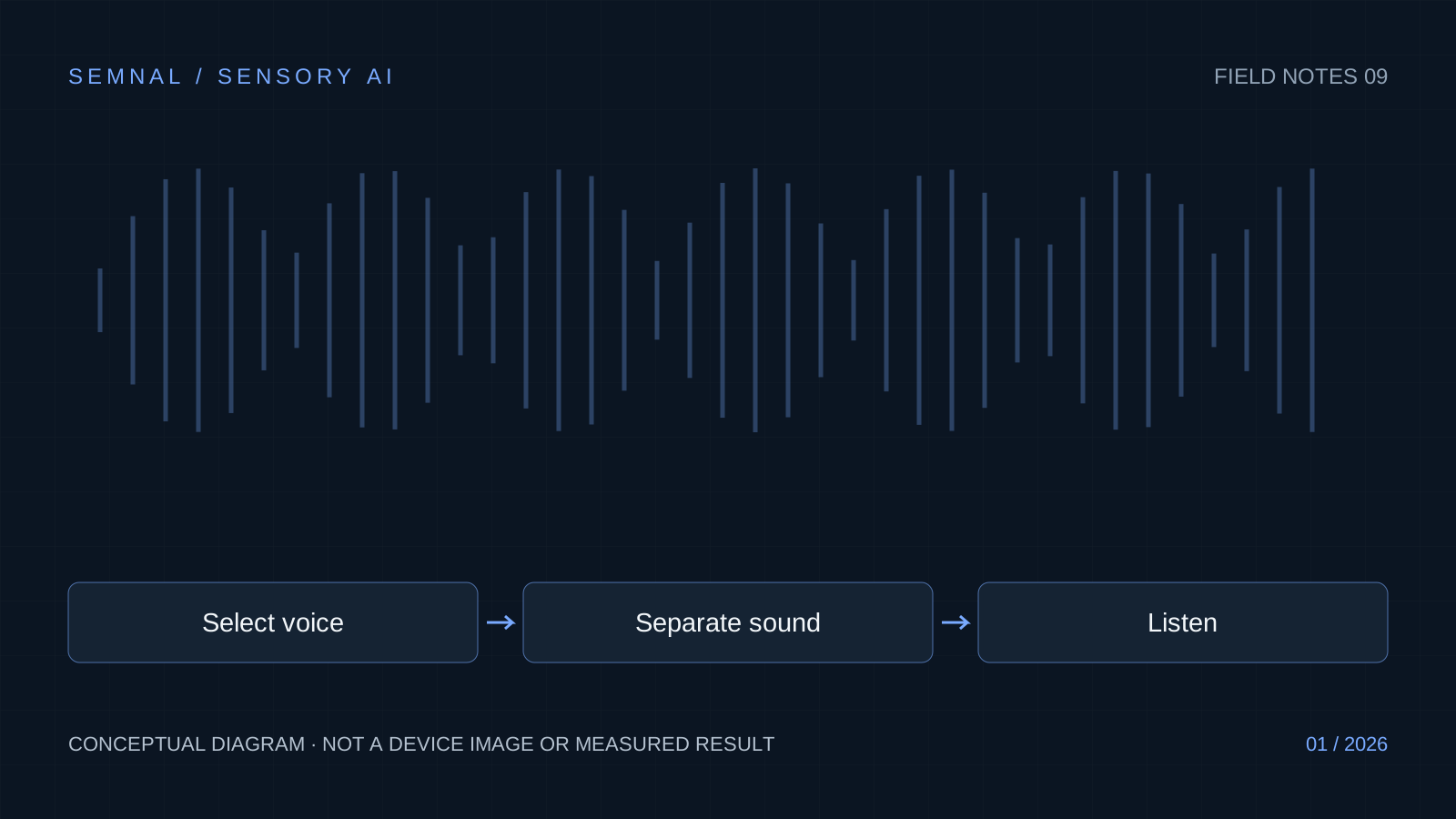
Original Semnal diagram. A simplified explanation, not a photograph of the device or a clinical result.
Sources and editorial note
Source note · 30 October 2026. Research dates refer to the original work. Prepared with AI assistance from the linked sources; no hands-on testing or interviews. Methods, disclosures and corrections.