



A conversation depends on timing as much as vocabulary. A speech interface that produces accurate words only after a long pause may still struggle to support interruption, humour or a quick reply. Streaming speech research is trying to close that gap.
Speech produced in successive pieces
NIH reported in April 2025 on a system tested with a 47-year-old woman who had severe paralysis following a stroke. Signals recorded from the surface of her brain were decoded into an audible voice in small successive chunks. The approach generated speech as it was being attempted, rather than waiting for a complete sentence. The report describes a single research participant, not a ready-to-use communication service. NIH
The value of joining at the right moment
The aim is to let someone join a conversation at the moment they choose. That is relevant to readers interested in communication technology, but this participant was not a woman over 50. Her experience should not be presented as direct evidence for our entire audience.
A personalised voice also raises a design question. A synthetic voice can carry someone’s identity, yet the person must retain control over what is said and when. Speed, errors, correction and the ability to remain silent deserve to be discussed together.
Why a pause can change a conversation
Imagine trying to answer a quick question while the other person is already moving to the next topic. Accurate words arriving late may still leave the speaker outside the exchange. Streaming aims to reduce that mismatch by producing smaller pieces of speech as the attempt unfolds. The scientific question includes timing, not just the number of correctly decoded words.
This is why a demonstration can be meaningful even before the system is ready for broad use. It tests whether an interface can participate in the rhythm of conversation. The next step is to understand how that rhythm holds up during corrections, interruptions and moments when the person decides not to speak.
A reconstructed voice is also an interface
The output has several jobs. It must convey the intended words, arrive at a useful moment and remain under the speaker’s control. A personalised voice adds another layer: it can make the output feel connected to the person, but that connection makes errors particularly important to manage. A sentence spoken in a recognisable voice should not acquire extra authority merely because it sounds familiar.
Consider a hypothetical correction. If the decoder produces a wrong word, the user needs a practical way to stop, revise or reject it. Counting successful sentences without examining that process would miss part of the communication burden. These are proposed evaluation questions, not a claim that the system in this study lacks such controls.
What the participant’s age does—and does not—tell us
The woman in the NIH account was 47. That does not make the technology irrelevant to a publication for women over 50. It means the article should be precise about the evidence instead of describing her as a representative older participant. Readers can be interested in communication technology as potential users, family members, scientists or informed citizens.
The more useful question is which aspects of the result might need further testing across people: the neural signals, the support arrangements, the interface and sustained use. Age alone cannot answer those questions. Neither can a single successful demonstration.
For a complementary view, the home-use speech interface study examines a different part of the problem: maintaining communication over an extended period outside a laboratory. Streaming and long-term use should not be collapsed into one claim about one device. Together, they show the field’s two practical ambitions—speaking at the right moment and being able to do so when everyday life requires it.
The unanswered question of ordinary use
Repeated use by more participants, clear accounts of mistakes and practical setup information would make the next results more informative. Words per minute alone cannot tell us whether someone can use the system comfortably through an ordinary day.
Research image and context
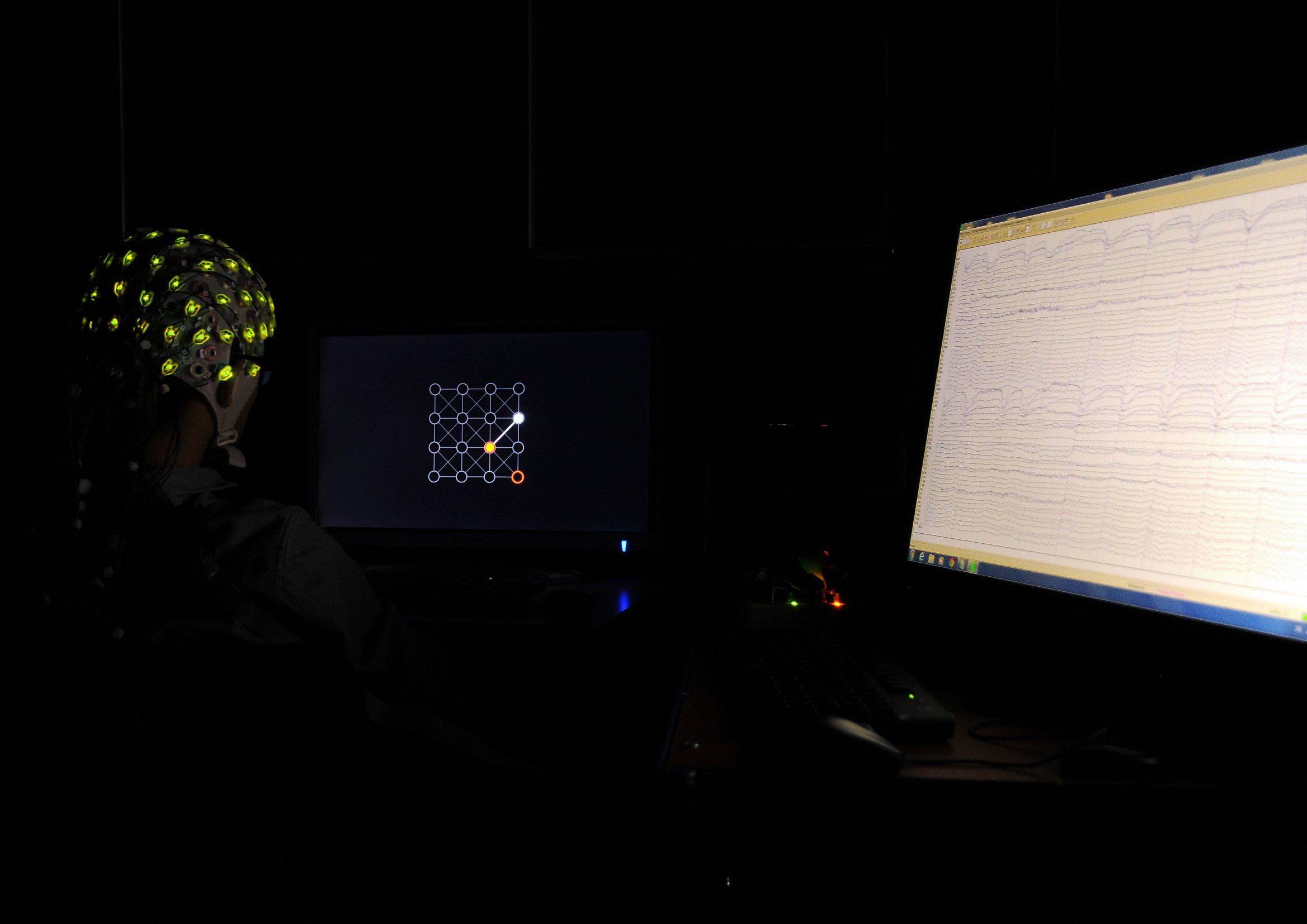 View original image · Full resolution (1.2 MB)
Context photograph of an EEG-based computer-control experiment. This is not the implanted speech interface or participant discussed in this article. Brain-computer interface experiment. The participant (left) is wearing an EEG cap. Their brain activity (right) is recorded and interpreted in real time to steer a cursor on the screen (middle). Context photograph; not the featured study or product unless explicitly identified. Credit: Laurens R. Krol. CC BY 4.0.
The idea in view
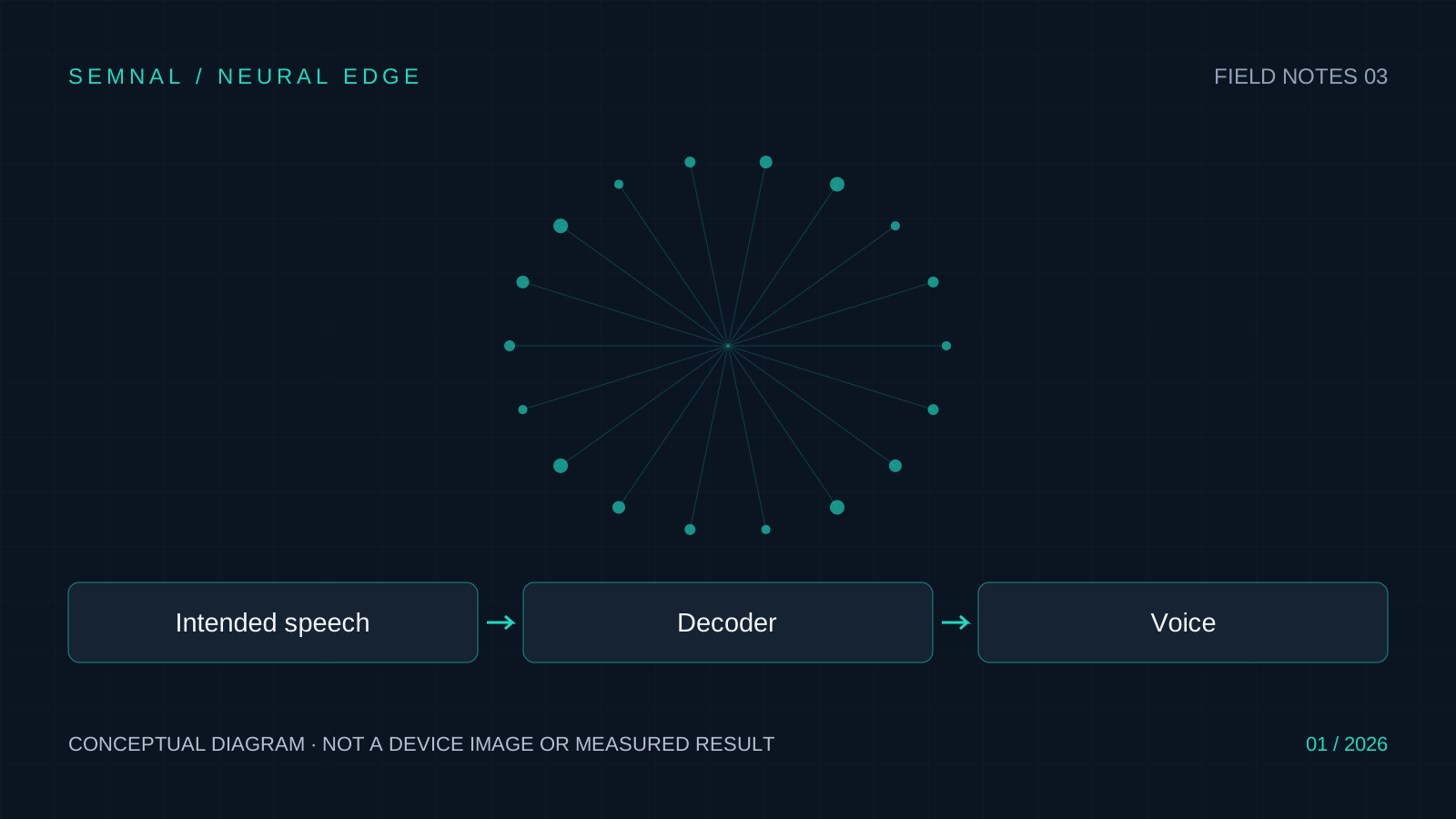
Original Semnal diagram. A simplified explanation, not a photograph of the device or a clinical result.
Sources and editorial note
Source note · 7 September 2026. Research dates refer to the original work. Prepared with AI assistance from the linked sources; no hands-on testing or interviews. Methods, disclosures and corrections.