
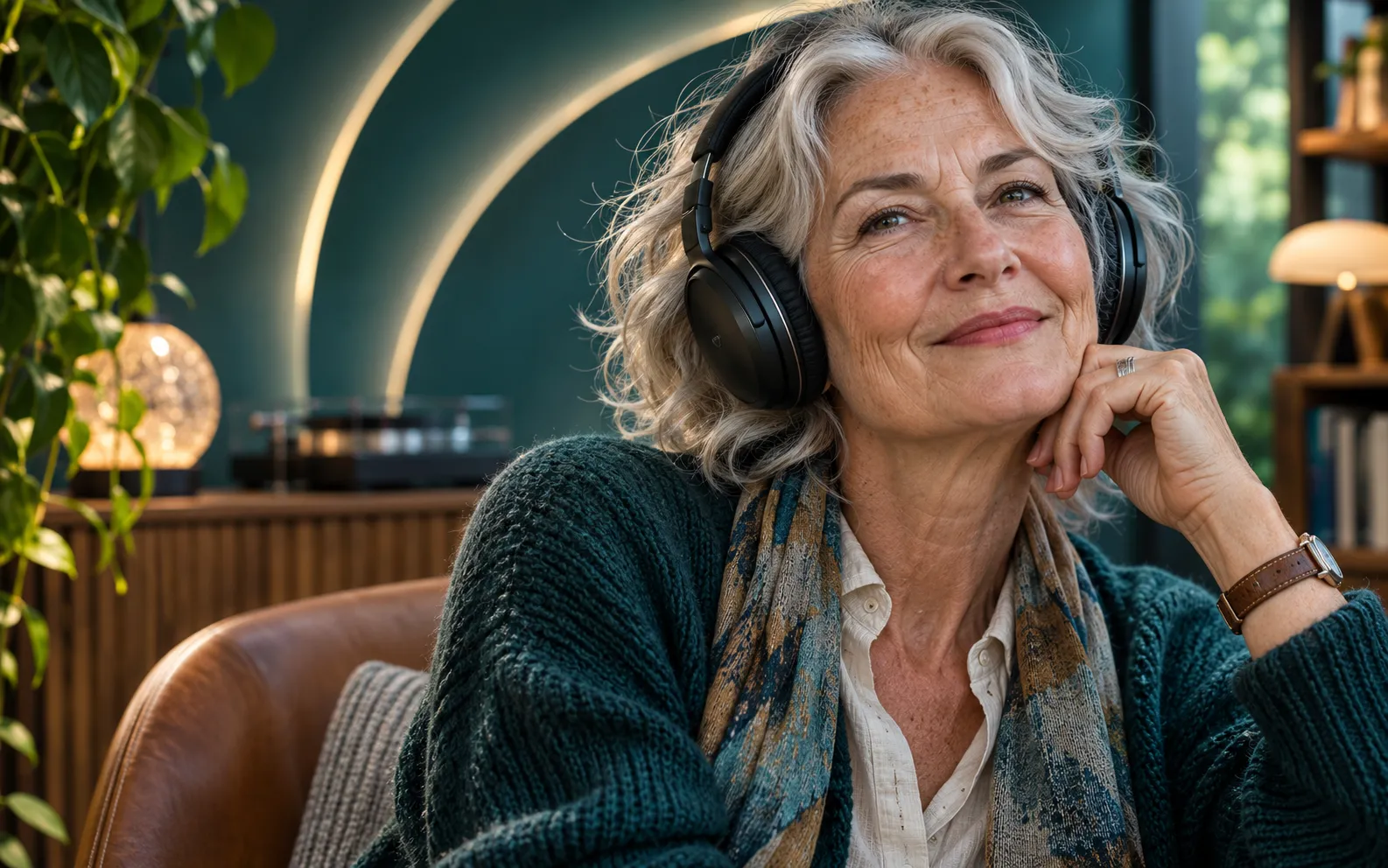
A useful listening boundary might be spatial: hear the conversation beside you, soften the conversation across the room. That is the idea behind research into a sound bubble, where distance becomes part of the audio interface.
A prototype that filters by distance
In a November 2024 report, the University of Washington described experimental headphones using a microphone array and AI to preserve nearby sounds while reducing sounds farther away. Unlike ordinary noise cancellation, the research attempts to distinguish sounds by their distance from the wearer. The university account describes a prototype and research evaluation, not a clinical trial proving benefit for older listeners. University of Washington
The person across the room still matters
Distance is a simple idea to explain, but social importance does not follow a fixed radius. A friend may step away; an announcement may come from across the room. Semnal’s view is that control of the boundary and the ability to hear beyond it are as important as the strength of suppression.
This is a promising direction for readers interested in easier participation in noisy places. It is not enough, however, to play a convincing before-and-after audio sample. The evaluation needs to establish who listened, what they understood and whether the setting resembled their daily environment.
A boundary that moves with conversation
A practical evaluation should include moving speakers, reflective rooms and changes of attention. Weight, comfort and adjustment effort belong in that assessment. The purpose should be a more usable sound environment, not isolation by default.
Distance is one possible selection rule
The Target Speech Hearing project asks which voice to retain; a sound bubble asks which region to retain. Picture two friends sitting close together: a distance boundary may keep both voices, while speaker selection aims to separate them. This hypothetical example explains the difference in task, not a head-to-head test of the prototypes.
Sources and editorial note
Source note · 11 August 2026. Research dates refer to the original work. Prepared with AI assistance from the linked sources; no hands-on testing or interviews. Methods, disclosures and corrections.