



Selecting a speaker once is one approach. Recognising an unfolding conversation is another. Proactive hearing assistants investigate whether the rhythm of turn-taking can tell a device which voices belong to the exchange its wearer is joining.
What the recordings establish
A University of Washington project presented at EMNLP 2025 uses the wearer’s own speech as an anchor, together with conversational dynamics, to identify conversation partners. Its description reports testing on recordings collected from 11 participants, totalling 6.8 hours. A fast streaming model and a slower contextual model work together. This is an evaluation of an audio system, not a trial showing medical benefit. University of Washington
When software infers a social group
The attractive part is reduced interaction: the user may not need to keep choosing a target. The difficult part is that the device now makes a social inference. A pause may be thoughtful listening rather than disengagement. A quiet speaker may matter as much as a frequent speaker.
For our audience, a meaningful study would examine whether the system handles different conversational styles without forcing the wearer to change their behaviour. Age and gender should be investigated through actual participants and outcomes, not inferred from the product’s friendly description.
Two models, two timescales
The project combines a fast model for ongoing audio separation with a slower model that considers a longer stretch of conversation. The fast component runs every 12.5 milliseconds, while the slower one helps interpret the pattern of interaction. A useful analogy is the difference between hearing the current sound and remembering who has been exchanging turns. The analogy explains the architecture; it does not imply human social understanding.
The test material consisted of 6.8 hours of recordings collected from 11 participants. That describes an audio evaluation set, not 6.8 hours of improved hearing in a clinical population. The relevant result is evidence that the system can identify and isolate conversational partners in the tested settings. Whether it improves communication for people with hearing difficulties is a further question. Research project
Participation can be quiet
Consider a book-club discussion. A person may listen closely for several minutes without speaking. Another participant may answer briefly and then fall silent. A system that uses conversational dynamics has to decide whether these people still belong to the exchange. Silence is therefore a useful test case, not merely an absence of input.
There is also a difference between identifying the group and understanding the wearer’s preference. A nearby exchange may be interesting even if the wearer has not yet joined it. A useful interface should leave room for that choice. These are design questions raised by the research, not evidence that the prototype necessarily fails in those circumstances.
Who should make the final selection?
Compare this with Target Speech Hearing, which gives the wearer an explicit initial choice. Automatic selection could reduce effort, but it should not make correction difficult. A clear way to broaden listening, change partners or turn assistance off could be as important as the quality of separation when the inference is right.
For an independent technology publication, this is the stronger story: AI is moving from filtering sound to making decisions about interaction. That creates an opportunity to make listening easier, and a responsibility to make those decisions understandable. The task is not just to remove noise. It is to preserve the wearer’s freedom to decide what counts as relevant sound.
The evidence needed next should connect that interface to people. Do users notice a wrong selection? Can they correct it without disrupting the exchange? Does the system reduce the effort of following a conversation? Those answers would tell us more about everyday value than another polished audio demonstration alone.
The importance of an override
Mistaken selection, override controls and audio retention deserve as much scrutiny as successful demonstrations. A conversation-aware system earns trust by being understandable when it gets the conversation wrong, as well as helpful when it gets it right.
Research image and context
 View original image · Full resolution (0.3 MB)
Context photograph of a laptop microphone array. It is not the proactive-hearing research hardware. Array of microphones built into a laptop Context photograph; not the featured study or product unless explicitly identified. Credit: Zvsmedia. CC BY-SA 4.0.
The idea in view
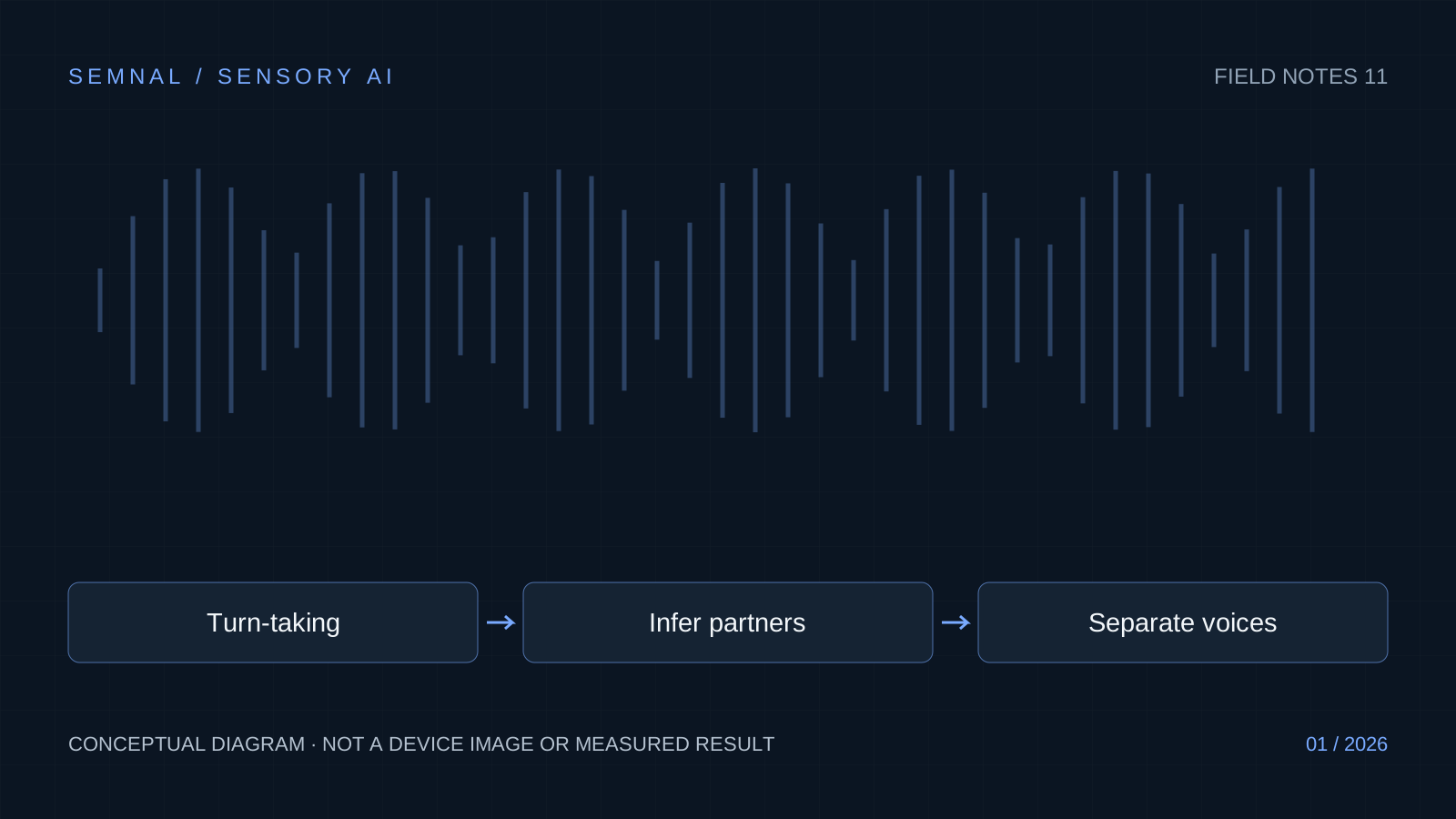
Original Semnal diagram. A simplified explanation, not a photograph of the device or a clinical result.
Sources and editorial note
Source note · 20 April 2026. Research dates refer to the original work. Prepared with AI assistance from the linked sources; no hands-on testing or interviews. Methods, disclosures and corrections.