



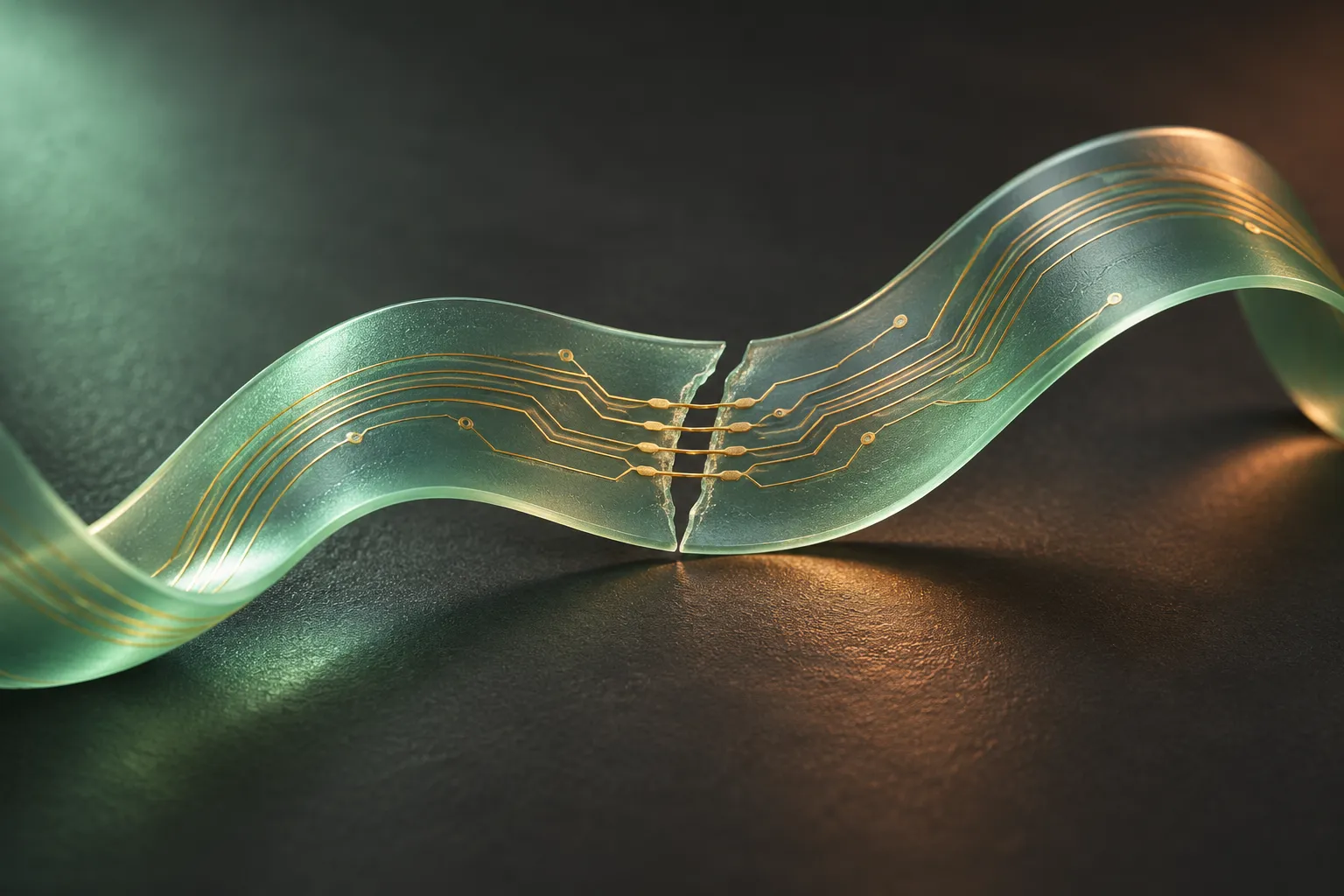
A wearable sensor is useful only while its material and electrical behaviour remain dependable. Self-healing electronics research asks whether damaged structures can recover—but recovery has to mean more than a crack becoming less visible.
A review of material strategies
A 2023 Frontiers in Chemistry review surveys stretchable semiconductors and self-healing conductors for flexible electronics. It discusses material designs and outstanding challenges rather than reporting a clinical trial of a finished wearable. The review is a map of research directions, not proof that a particular commercial sensor can repair itself in everyday use. Frontiers in Chemistry
Repairing a crack is not enough
Mechanical recovery and measurement recovery need separate tests. A material might reconnect while its signal changes enough to require recalibration. For an eventual device, the important question is whether the user can rely on the output after damage, and how the system indicates uncertainty.
This matters to anyone interested in wearable technology that fits ordinary life rather than a carefully controlled demonstration. It does not establish an age-specific benefit. Women over 50 should be included in the design of relevant applications, but the material alone cannot tell us whether the complete device will be comfortable or useful.
After recovery, check the measurement
Repeated damage-and-recovery cycles need to specify the conditions for healing and the accuracy of measurement afterwards. Heat, time or special handling may change the practical meaning of ‘self-healing’. The compelling frontier is dependable function after wear—not an evocative label attached to a flexible sample.
The repair claim needs a test condition
A meaningful report specifies the damage, the recovery process and the function measured afterwards. It also states whether the process can be repeated. Those details let a reader distinguish a material’s demonstrated behaviour from a proposed wearable application. The electronic-skin brief shows why the quality of the recovered signal matters as much as flexibility.
Sources and editorial note
Source note · 29 April 2026. Research dates refer to the original work. Prepared with AI assistance from the linked sources; no hands-on testing or interviews. Methods, disclosures and corrections.