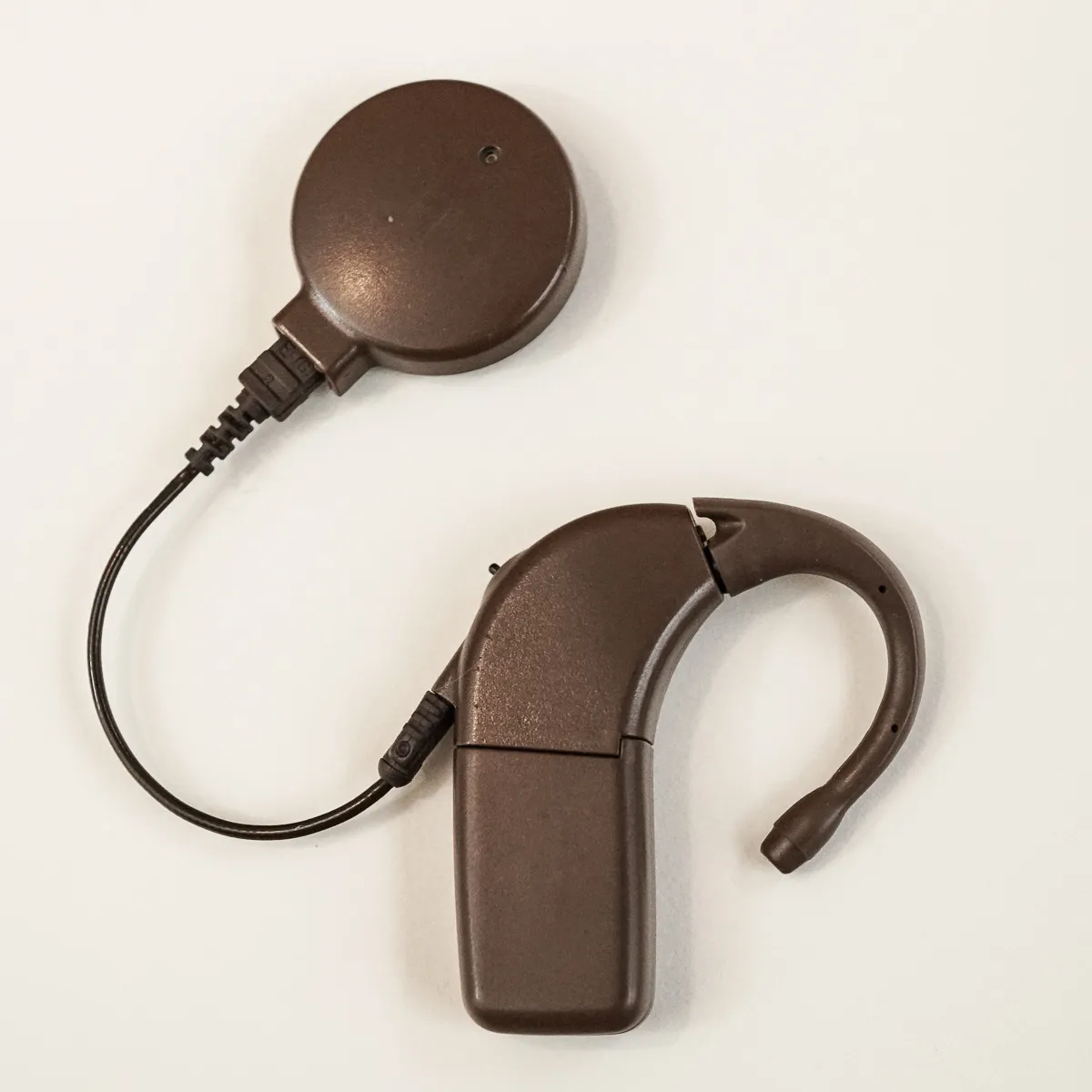




A retinal implant is not a replacement eye. It tries to deliver useful signals through a visual system that still has functioning components. Understanding where those signals enter is essential to understanding which kind of vision loss a device might address.
The trial: benefit and adverse events
The PRIMA study, published online in 2025 and in a 2026 NEJM issue, examined a photovoltaic implant for geographic atrophy due to age-related macular degeneration. Thirty-eight people received an implant; 32 were assessed at 12 months, and 26 of those met the study’s meaningful visual-acuity improvement threshold. The report also recorded 26 serious adverse events in 19 participants. These numbers describe a particular trial, not a promise of normal vision. NEJM trial record
Reading vision is a specific outcome
This is directly relevant to a publication interested in later-life vision, but the intervention is condition-specific. A result in geographic atrophy does not establish treatment for every retinal disease or for problems in the cornea. The device and its external optical equipment should be considered together.
Semnal’s editorial question is what an acuity improvement makes possible in practice, and at what cost in surgery, training and effort. It is equally important to understand the people missing from follow-up; a percentage among those assessed is not automatically the percentage among everyone implanted.
What the implant adds to the visual pathway
PRIMA combines a retinal implant with external optical equipment. The company describes glasses that project near-infrared light onto the photovoltaic implant, which turns that input into electrical stimulation. Magnification is part of the system. This is therefore not a tiny chip working alone: the implant, glasses, processing and learning all belong to the intervention. System description
That helps explain why reading results need context. Recognising letters using a prosthetic system is a meaningful achievement, but it does not describe every aspect of vision. Reading speed, the effort of scanning a page and performance in a changing environment are distinct questions. A visual-acuity threshold cannot stand in for the whole experience of reading a letter from a friend.
Keep the denominator in view
Thirty-two of the 38 implanted participants were assessed at twelve months. Twenty-six of those assessed met the improvement threshold. Keeping both numbers in the sentence matters: describing a percentage among those assessed as a percentage of everyone implanted changes the claim. The adverse-event count is also a count of events, not a count of additional people. Some participants can experience more than one event.
These distinctions do not diminish the achievement. They make it possible to assess the benefit and burden together. A reader should be able to understand what improved, who contributed to the analysis and what happened during the treatment pathway without reconstructing the trial from a promotional headline.
The access story changed in July 2026
On 22 July 2026, Science announced European commercial launch following CE marking under the EU Medical Device Regulation. The announcement also said that country-specific reimbursement applications and clinical-site activation were underway. It stated that PRIMA was not commercially available outside the EU/EEA. These are the company’s dated access statements, separate from the trial results. Launch announcement
CE marking therefore moves the discussion beyond an entirely experimental European pathway, but it does not establish an appointment, payment arrangement or suitable treatment for an individual reader. Nor should US Breakthrough Device or Humanitarian Use Device designations be described as US marketing approval.
For a woman with geographic atrophy, the important change is that there is now a more concrete European access question to investigate. For someone with another cause of reduced vision, the same announcement may have little direct relevance. The responsible excitement lies in a specific route towards useful reading vision, with an equally specific set of clinical and practical conditions.
Beyond the twelve-month result
Read benefit and adverse-event results side by side. Longer follow-up, real-world tasks and current local regulatory status are separate pieces of evidence. This article does not establish that the device is available for routine treatment in the reader’s country.
The idea in view
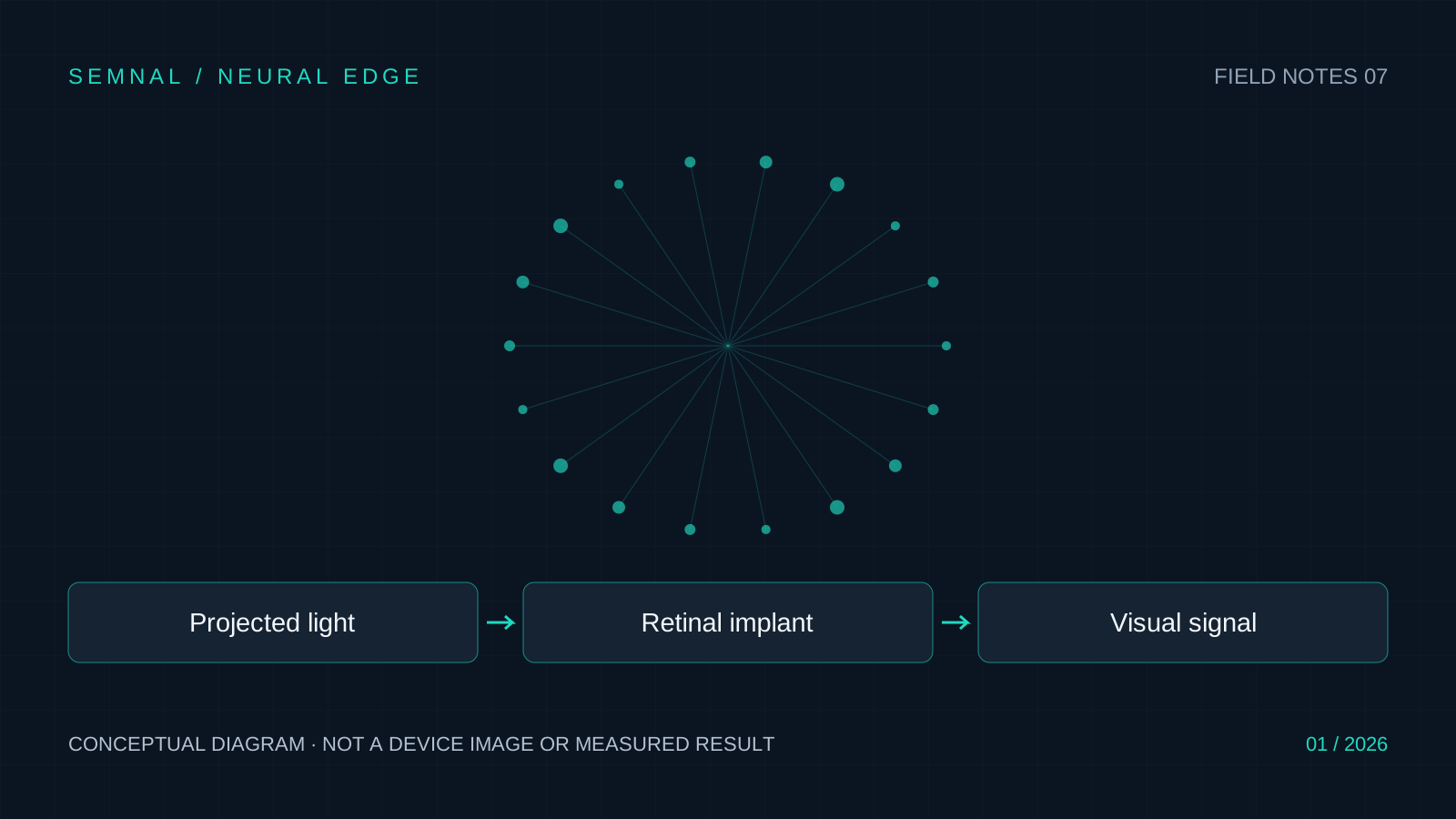
Original Semnal diagram. A simplified explanation, not a photograph of the device or a clinical result.
Sources and editorial note
Source note · 10 October 2026. Research dates refer to the original work. Prepared with AI assistance from the linked sources; no hands-on testing or interviews. Methods, disclosures and corrections.